In this paper, we focused on the coolest class of brown dwarfs, called Y
dwarfs.
While
recent years have seen a surge of observations and modelling efforts focused
on
these
objects, 3D circulation models of Y dwarfs
are a largerly unexplored area of research.
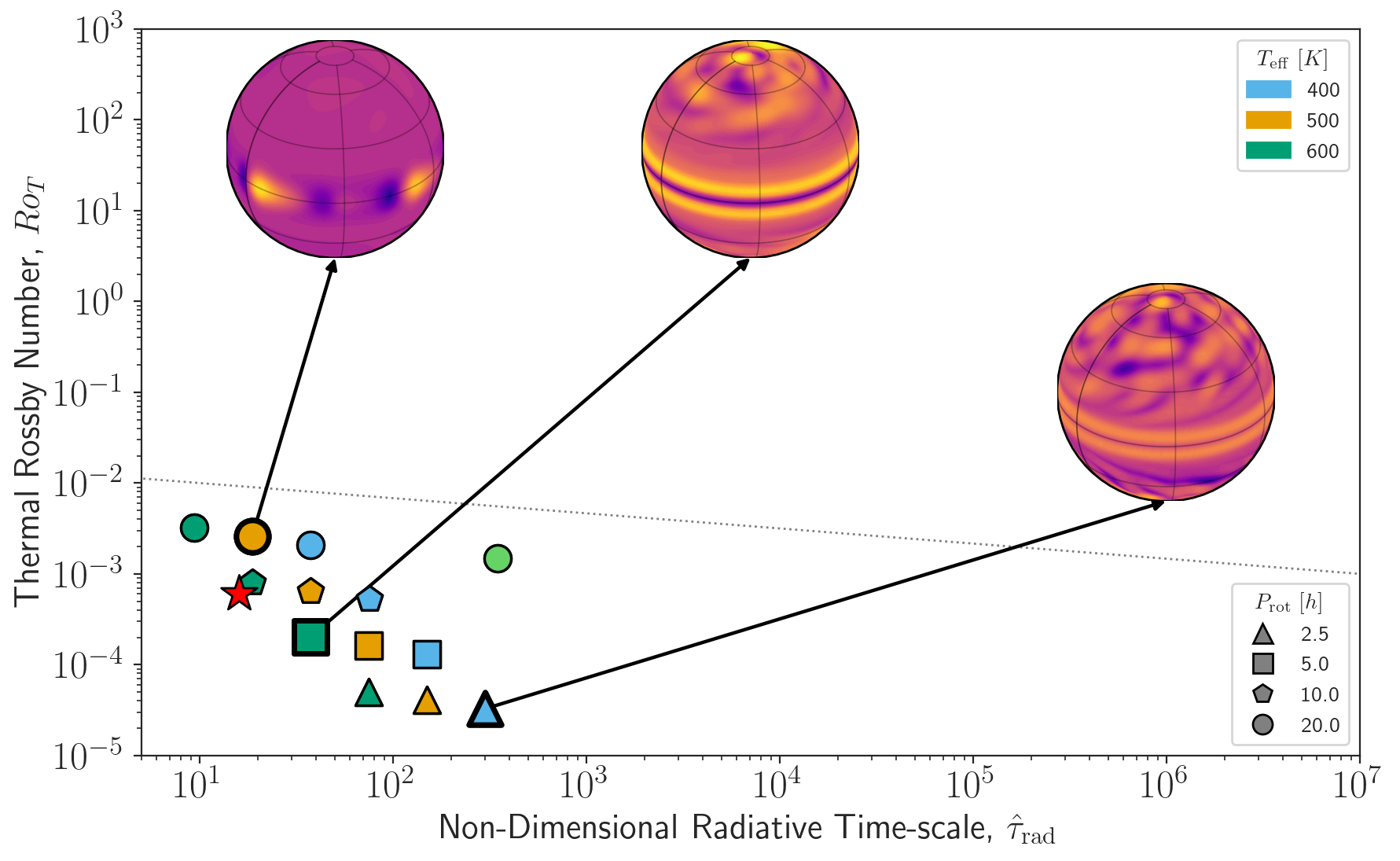
For this purpose we curated a sample of models spanning the parameter space
of
temperature
ranges $400~\mathrm{K} \leq T_{\mathrm{eff}} \leq 600~\mathrm{K}$ and
rotation rates
$P_{\mathrm{rot}} = 2.5 ~\text{-} 20\, \mathrm{h}$, effectively covering
possible Y
dwarf configurations. Additionally, we included multiple salt
($\mathrm{KCl},\,\mathrm{Na_{2}S}$) and sulfide ($\mathrm{MnS}$) species in
our
simulations to probe the interplay of rotation, convection and cloud thermal
feedback
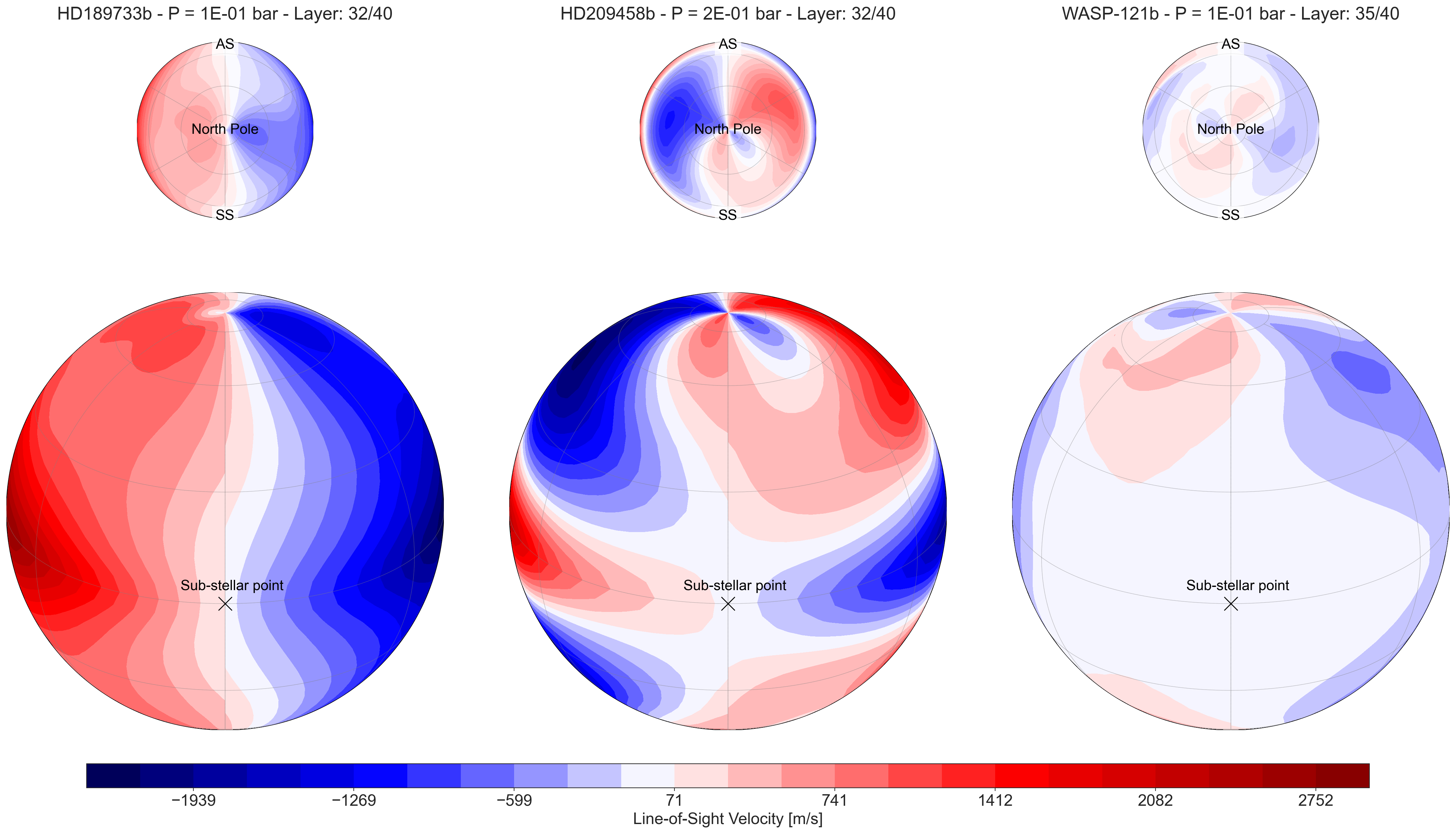
effects. The resulting Y dwarf atmospheres are weakly dynamic and less
variable than
observations, resulting in our conclusion that the physical mechanisms
behind their
observed
variability remains unknown.
This paper is my second first-author paper and also the final paper of my
PhD. A
result
of my growing interest into performing 3D simulations brown dwarf
atmospheres, it resulted in the development of many new physics modules for
our
in-house
GCM THOR. The modifications can be found on my private GitHub repository
linked
below.
Published
Paper (A&A, 2026)
Code